Lucknow: In a significant push toward rural economic transformation, the Uttar Pradesh government is set to convert traditional goshalas into vibrant economic hubs, leveraging technology, sustainability, and indigenous resources. Under the direction of Chief Minister Yogi Adityanath, the state is working on an ambitious plan to develop a “technology-based cow conservation model,” where goshalas will not only serve as shelters but also emerge as drivers of employment and income generation.
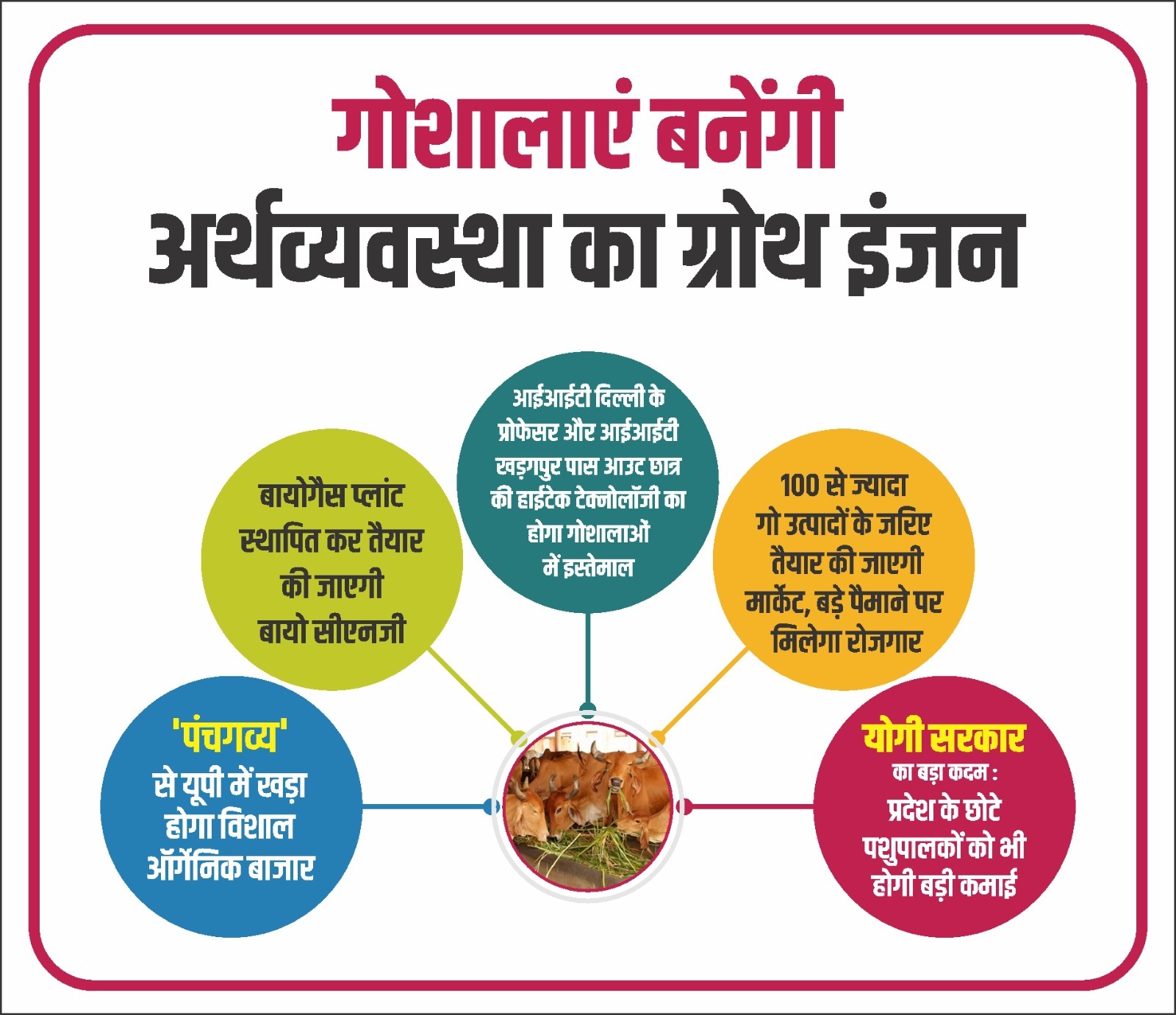
At the heart of this initiative lies the concept of the “Panchgavya Value Chain”—a traditional system utilizing cow-derived products such as cow urine, dung, milk, curd, and ghee. The Uttar Pradesh Cow Service Commission has drawn up a comprehensive blueprint to develop over 100 organic products based on these components, aiming to create a large-scale, sustainable organic market across the state.
High-Tech Integration Meets Tradition
What sets this initiative apart is the integration of cutting-edge technology with traditional knowledge systems. Experts from premier institutions such as Indian Institute of Technology Delhi and Indian Institute of Technology Kharagpur are playing a key role in designing and implementing this model.
The project will see the installation of advanced biogas plants in goshalas, enabling the production of bio-CNG, along with organic fertilizers and other Panchgavya-based products. These plants will ensure efficient utilization of cattle waste, converting it into clean energy and commercially viable outputs.
The first pilot project is being rolled out in Jalaun district, where selected goshalas are being upgraded into high-tech, self-sustaining units. If successful, the model will be replicated across the state, potentially transforming thousands of goshalas into economic centers.
Training and Skill Development at the Grassroots
To ensure smooth implementation, technical teams led by experts such as Professor V.K. Vijay from Indian Institute of Technology Delhi will conduct on-ground training programs in rural areas. These initiatives aim to equip local communities with the skills required to operate biogas plants and manage production processes efficiently.
This focus on skill development is expected to create a pool of trained manpower within villages, reducing dependency on external expertise while boosting local employment.
From Production to Market: End-to-End Support
Beyond production, the initiative also emphasizes branding, marketing, and distribution. Yashraj, an alumnus of Indian Institute of Technology Kharagpur who left a high-paying corporate job to join the project, is leading efforts to build a strong market ecosystem for Panchgavya products.

His team will assist in product development, packaging, branding, and market linkage, ensuring that goods produced in rural goshalas find competitive positioning in urban and national markets. This integrated approach is expected to significantly enhance the commercial viability of the initiative.
Boost for Small Farmers and Rural Youth
One of the most impactful aspects of the योजना is its focus on inclusivity. Small livestock farmers, who often struggle with limited income streams, stand to benefit directly from the initiative. By monetizing cow-based products, they can access new revenue channels and secure better returns.
Additionally, the creation of decentralized production units in villages is expected to generate large-scale employment for rural youth. From operating biogas plants to manufacturing organic goods and managing supply chains, the initiative offers diverse livelihood opportunities.
Dual Benefits: Conservation and Commerce
According to Uttar Pradesh Cow Service Commission Chairman Shyam Bihari Gupta, the model offers dual advantages. “It ensures the protection and welfare of cattle while simultaneously opening new avenues of income and employment for farmers and youth,” he noted.
The convergence of traditional practices with modern technology is being seen as a game-changer for rural economies. By transforming goshalas into self-reliant, revenue-generating entities, the government aims to create a sustainable ecosystem that benefits both livestock and livelihoods.
Key Highlights of the Initiative
- Development of over 100 organic products using Panchgavya components
- Installation of biogas plants to produce bio-CNG and organic fertilizers
- Pilot project underway in Jalaun district
- Technical training by IIT experts for rural communities
- End-to-end support for product development, branding, and marketing
- Direct income boost for small farmers and employment generation for rural youth
A New Model for Rural India
This initiative reflects a broader vision of transforming rural Uttar Pradesh into a hub of innovation, sustainability, and economic activity. By combining indigenous knowledge systems with modern scientific approaches, the state is attempting to build a scalable model that could serve as a template for the rest of India.
If successfully implemented, Uttar Pradesh’s technology-driven goshalas could redefine the role of cattle in the rural economy—moving beyond traditional utility to become engines of growth in an emerging organic marketplace.